
ADDITIONAL MENU
Peer Review
1. Peer Review Process
The Journal of Principles Management and Business (JPMB) applies a double-blind peer review process to evaluate the quality, originality, relevance, and academic contribution of submitted manuscripts. Under this system, the identities of authors and reviewers are concealed from each other during the review process.
Each submitted manuscript undergoes an initial editorial screening before being considered for external peer review. Manuscripts that meet the journal's preliminary requirements are sent to two independent reviewers with relevant expertise in the subject area.
The final publication decision rests with the editor, taking into account the reviewers' comments, the authors' revisions, the manuscript's scholarly quality, and its compliance with the journal's policies.
2. Stages of the Review Process
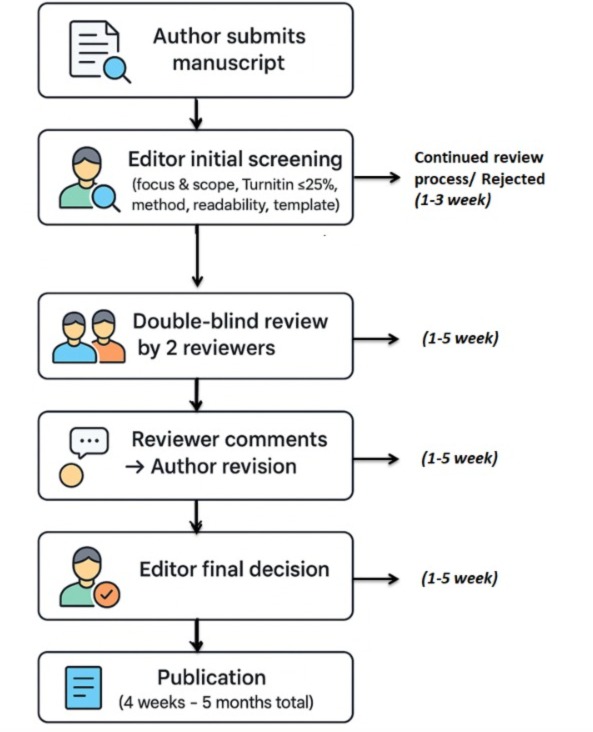
2.1. Manuscript Submission
Authors submit their manuscripts through the journal's online submission system and must comply with the journal's Author Guidelines. Submissions should fall within the journal's focus and scope and meet the applicable requirements for manuscript preparation.
2.2. Initial Editorial Screening
The editor conducts an initial assessment to determine whether the manuscript is suitable for further review. The screening considers:
-
Relevance to the journal's focus and scope.
-
Compliance with the manuscript template and submission requirements.
-
Originality and the results of plagiarism screening.
-
Adequacy of the research methods and analysis.
-
Readability, structure, and basic academic writing quality.
JPMB uses Turnitin or an equivalent plagiarism detection tool to assist in screening manuscripts. The journal applies a maximum similarity threshold of 25%, subject to the journal's screening procedures. Similarity scores are assessed in context, and a score alone does not determine whether plagiarism has occurred.
Manuscripts that do not meet the journal's requirements may be rejected at this stage or returned to the authors for improvement. Initial screening generally takes approximately 1–3 weeks.
2.3. Double-Blind Peer Review
Manuscripts that pass the initial screening are assigned to two independent reviewers with appropriate expertise. Reviewers do not receive the authors' identities, and authors are not informed of the reviewers' identities.
Reviewers evaluate manuscripts based on the following criteria:
-
Originality and contribution to existing knowledge.
-
Relevance to the journal's focus and scope.
-
Adequacy of the theoretical framework and literature review.
-
Appropriateness of the research design, methods, and data analysis.
-
Clarity and validity of the findings and discussion.
-
Relevance of the conclusions to the research objectives.
-
Quality of academic writing, citations, and references.
-
Compliance with research and publication ethics.
The external review stage generally takes approximately 1–5 weeks, depending on reviewer availability and the complexity of the manuscript.
2.4. Reviewer Recommendations
Reviewers provide comments and recommendations to assist the editor in making an informed decision. Recommendations may include:
-
Accept: The manuscript is suitable for publication without substantial revision.
-
Minor Revision: The manuscript requires limited changes before a decision can be made.
-
Major Revision: Substantial revisions are required before further consideration.
-
Reject: The manuscript does not meet the journal's publication requirements.
Reviewer recommendations are advisory. The editor makes the final editorial decision after considering the reviews and the overall quality and suitability of the manuscript.
2.5. Revision by Authors
When revisions are requested, authors must respond to the reviewers' comments and provide a revised manuscript within the deadline specified by the editor. Authors are encouraged to submit a point-by-point response explaining how each comment has been addressed or providing a reasoned explanation when a suggestion is not adopted.
Revised manuscripts may be returned to the original reviewers for further evaluation or assessed by the editor, depending on the nature of the revisions.
2.6. Final Editorial Decision
The editor evaluates the reviewers' recommendations, the revised manuscript, and the authors' responses before making a final decision. The editor may accept the manuscript, request further revision, or reject it if the required standards have not been met.
Completion of the review process does not guarantee acceptance. All manuscripts must satisfy the journal's academic, editorial, and ethical requirements.
2.7. Copyediting and Publication
Accepted manuscripts proceed to copyediting, proofreading, layout, and other necessary production stages before publication. Authors may be asked to check the proofs and correct production errors.
JPMB publishes two issues per year, in June and October, according to its stated publication schedule. Acceptance does not necessarily mean that an article will appear in the immediately upcoming issue, as publication depends on editorial scheduling and production requirements.
3. Review Timeline
The following timelines are estimates and may vary according to reviewer availability, revision requirements, and editorial workload:
-
Initial editorial screening: approximately 1–3 weeks.
-
External peer review: approximately 1–5 weeks.
-
Author revision: according to the deadline specified by the editor.
-
Final editorial assessment: depends on the completeness of revisions and the need for further review.
-
Overall process from submission to publication: approximately 4 weeks to 5 months.
These estimates are indicative and do not constitute a guarantee of a particular editorial decision or publication date.
4. Confidentiality and Ethical Responsibilities
Editors, reviewers, and editorial staff must treat submitted manuscripts and review reports as confidential. Manuscripts under review must not be shared with unauthorized persons or used for personal advantage.
Reviewers must provide objective and constructive evaluations, disclose potential conflicts of interest, and inform the editor of suspected plagiarism, substantial overlap, or other possible research integrity concerns.
Authors must ensure that their submissions are original, accurately reported, properly cited, and compliant with the journal's publication ethics requirements.
5. Editorial Independence
Editorial decisions are based on the scholarly quality, relevance, originality, methodological soundness, and ethical compliance of the manuscript. Decisions must not be influenced by the authors' personal characteristics, institutional affiliations, or other irrelevant considerations.
The editor retains responsibility for the final decision, taking account of the reviewers' assessments and the journal's editorial policies.
6. Appeals and Complaints
Authors who believe that an editorial decision resulted from a factual error or a significant procedural irregularity may submit a reasoned appeal to the editorial office. Appeals must clearly explain the grounds for reconsideration and should address relevant aspects of the review or decision.
The editor or an appropriate independent editorial representative will assess the appeal. An appeal does not guarantee reversal of the original decision. Complaints concerning the review process or potential conflicts of interest will be considered fairly and handled in accordance with the journal's publication ethics principles.